

Open Access, Research
Playing outdoors in Dutch cities: how children perceive and value the public space as a place to play
June 18, 2026
|
Thank you to Gerben Helleman, PhD candidate at Delft University of Technology, for providing this post.
Playing outdoors: how children perceive and value the public space as a place to play
Outdoor play can positively affect children’s personal development and health. But how do children perceive and value public space as a place to play, and which factors influence their perceptions and valuations? A total of 89 Dutch children, aged 5 to 11 years, participated in the study. Using photovoice and walk-along methodologies, children told and showed us their favorite and least favorite play spaces.
Perception of public outdoor space as a place to play
Results showed that children perceive their environment in diverse ways. It is mainly the formal play space (playgrounds, schoolyards, sports fields) that children associate with playing outside. This makes sense, as children respond directly to the meaning and function of these places. Many stories and experiences were therefore about play opportunities that were directly linked to a specific play attribute: children slide down the slide and do tricks on the tumbling bars.
Play elements in playgrounds that deviate from the standard are used more freely, such as an element that looks like a large whale that, next to the slide, is also used to climb, jump off, and hide in. Form and function are less attuned to each other here, leaving more room for children’s creativity and imagination to give it a certain play value.
Besides engaging with the play opportunities offered to them in public space children also employ their creativity to reinterpret the public space to their liking by transforming ordinary objects into play attributes. Children showed or talked, for example, about how they ‘climb’ elements in public spaces, such as posts, fences or electricity boxes. In addition, attributes are regularly integrated into games. For example, an eight-year-old girl told how a pole, to prevent cars from parking there, had become part of a game she made up herself: whoever loses the game must jump over the pole. Other children also described games in which the environment plays a significant role.
According to a 10-year-old boy, hills are good hiding places during tag because the others cannot see you. A six-year-old girl always sits ‘behind the houses and behind the bushes’ during hide-and-seek.
In addition to perceiving physical characteristics, the children also indicated that they scan the social environment for potential play opportunities. This mainly concerned whether familiar, friendly playmates were present.
Valuing public outdoor space as a place to play
The children were generally positive about playing outside in their neighborhood. In doing so, the children identified a number of recurring environmental factors that they labelled as positive (‘nice’) or negative (‘not nice’). These were physical environmental factors (nice: variety of play spaces, challenging play elements, materials; not nice: lack of hygiene) and social environmental factors (nice: the presence of other children; not nice: bullying, social safety issues). These factors are in line with previous studies, but they are not identical. This study provided deeper insight into how Dutch children experience the public space for play in current society. It revealed that children prefer variety not only within playgrounds but also between playgrounds. It also showed that children seek challenges in several ways: they look for difficult, exciting, and exceptional play opportunities. In addition, children in this study emphasize other factors than in previous studies. For instance, they pay a lot of attention to the materials (‘that seesaw really makes too much noise’), surfaces (‘I really prefer artificial grass’), play elements where you can play together (‘a family swing where you all go on it together’), and bullying (‘He’s annoying too. We’re no longer friends with him’).
The above is a summary of the following article: Helleman, G., de Vries, S. I., & van Dorst, M. (2026). Playing outdoors in Dutch cities: how children perceive and value the public space as a place to play. Cities & Health, 1–13.
You can read the full article (including more results, discussion, and policy implications) for free at: https://doi.org/10.1080/23748834.2026.2677397.
Gerben Helleman is a PhD candidate at Delft University of Technology and a senior researcher at The Hague University of Applied Sciences. As an urban geographer, his work focuses on how people use the built environment. He has a special interest in the way children perceive, use, experience, and value different kinds of public spaces. On his blog ‘Urban Springtime‘, he writes about the relation between ‘the way a city is planned, designed and made by professionals’ and ‘the way a city is experienced, valued, and filled in by its users’. There and elsewhere, he published more than 30 reviews of books about children’s geographies, public spaces, and urbanism.
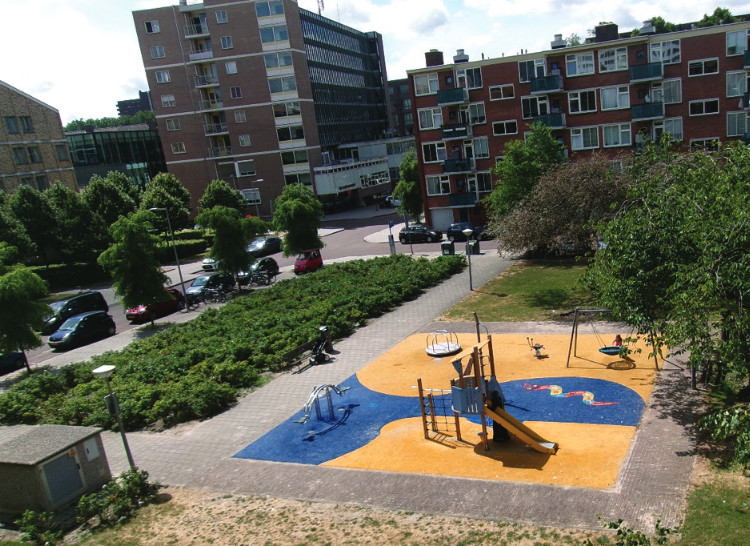
Photo provided by an eight-year-old boy of his favorite playground, taken from his balcony: ‘You can make goals to play football’, namely from the merry-go-round to the spring rider and from the seesaw to the climbing area.