

How Paris transformed 300 School Streets: A Step-by-Step guide
This article was first published by the Global Alliance – Cities4Children (www.cities4children.org/blog) and authored by Sarah Sabry and Anupama Nallari, Urban Hub @ Save the Children
Between 2020 and 2026, Paris transformed 300 school streets, fully redesigning around 100 of them. This article shares key lessons from the ground and practical steps to help other cities plan and implement their own school streets.
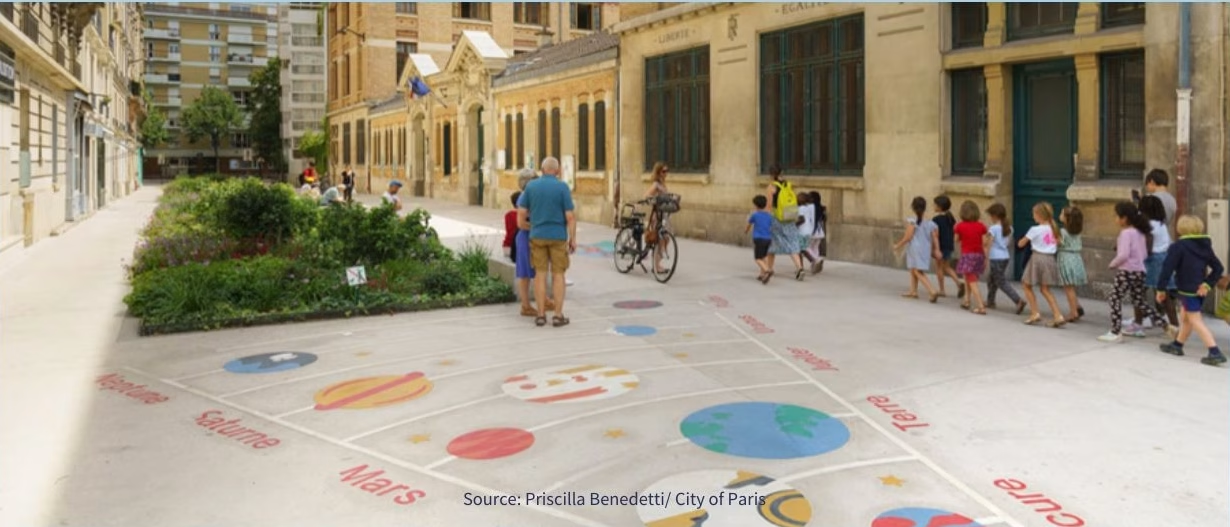
We spoke with Priscilla Benedetti, an Urban Planner with the City of Paris, to understand how this transformation happened, and we document the steps below to inspire other cities. The Paris school streets programme emerged from a blend of emergency action and structured neighbourhood planning. The slideshow shows the transformation of school streets in Paris from grey car-dominated streets to safer, greener and inclusive public spaces for all.
BEFORE: AFTER:


BEFORE: AFTER:


BEFORE: AFTER:


Source: Priscilla Benedetti/ City of Paris
How change started
When COVID-19 hit in early 2020, Paris’ narrow pavements quickly became a problem. At school pick-up and drop-off times, families were squeezed together with no room for social distancing. The city needed an immediate fix. Paris moved quickly, closing 50 streets outside schools almost overnight. The goal was simple: create more space for distancing. But the impact was bigger. Streets became calmer, the air felt cleaner, and families suddenly had space to socialise. These tactical changes revealed a larger opportunity: to rethink how streets support children’s and families’ everyday lives. At the same time, Paris was rolling out its long-term Improve Your Neighbourhood programme to transform daily public spaces to encourage families with young children to stay in Paris.
“As soon as young couples in the city have kids, most of the time they leave the city. And they go to the suburbs to have a better public space for kids. So we were asked to develop a new program to improve the environment for kids in the city.” said Priscilla.
The initiative involved working district by district to map traffic, consult residents and identify opportunities for public space improvements. The foundations for community-centred redesign were already in place.
Residents who experienced the early school streets soon asked for more. As Priscilla noted: “We are in a moment where people are wanting more for/from the city — not just basic infrastructure, but aesthetic quality, greenery, social life and health.”
These expectations aligned closely with former Mayor Anne Hidalgo’s agenda for a safer, greener and more people-friendly Paris. Under Hidalgo’s leadership, Paris reimagined schools as the “capitals” of neighbourhoods, with School Streets reducing traffic around them. These changes were paired with greener schoolyards—turned into “oases” and opened to residents beyond school hours as shared community spaces. Political will, holistic planning, and public demand created ideal conditions for the school streets initiative to scale.
In a dense city like Paris, Priscilla said that “Public space for kids is mostly the journey between home and school.” Making this journey safer and more pleasant suddenly felt urgent and possible.
This article focuses on implementation: how Paris advanced the initiative step by step, resolved challenges, built acceptance and set up a workflow capable of delivering hundreds of school streets quickly and effectively. The following 15 steps draw directly from our conversation with Priscilla.
How Paris implemented its school streets: 15 key steps
1. Start with a clear political mandate, budget and accountability
Following the 2020 municipal elections, improving neighbourhood living environments became a priority. Leaders asked technical teams to rethink how public space could be safer, more accessible and more child-friendly. The Improve Your Neighbourhood programme was launched with a budget of 5 million euros per neighbourhood to improve public space. Three teams in the city department worked closely to make this happen: the planning team, the technical drawing team and the building team.
2. Use emergency measures to test new ideas
During the first wave of COVID-19, Paris closed school streets using whatever materials were available, like concrete blocks, planters or simple barriers. These weren’t perfect, but they proved closures were feasible and popular.

3. Listen to and leverage citizen voices
COVID-19 sparked strong public interest in cleaner air and better outdoor spaces. Residents noticed the immediate changes outside schools, and many called for these benefits to continue. Engaging school communities early proved key to finding “allies,” as they helped build local support and acceptance for pedestrianisation projects during public consultations, giving the school streets programme both momentum and legitimacy.

4. Map locations frequented by children
For each neighbourhood, Paris created a comprehensive list of schools from nursery to university level, as well as public open spaces and facilities where children and young people gather, like parks and playgrounds, libraries, dance and music schools and other community spaces. The streets around these locations became the basis for prioritising pedestrianisation.
5. Understand the surrounding traffic patterns
Teams analysed traffic flows thoroughly to avoid shifting congestion to other streets. If closing a school street risked causing jams elsewhere, the city adjusted the wider traffic plan to avoid that. Some streets with essential services — like hospitals, bus routes or large shops — could not be closed. In such cases, the city sometimes changed the school entrance to quieter side streets, rather than abandoning the idea of pedestrianisation. Paris also offered subsidised underground parking to ease concerns about the loss of street parking.
6. Start with adaptable, easy-to-operate gates
Paris’ police department required that closures be fully accessible in emergencies. The city, therefore, opted for lightweight gates that parents or school staff could close during school hours, and emergency services could open instantly.
7. Test, be flexible, monitor, evaluate and build acceptance
Some residents were worried about the proposed changes. So, Paris created temporary school streets first, with temporary gates, markings and signs, and observed them for six months. In nearly all cases, these temporary changes proved successful, and residents requested permanent improvements.
This testing period was crucial not just for community buy-in, but for refining designs. Early placements didn’t always work:
“When we put the gate in a straight line, bicycles sped on the sidewalk next to the school, and this was dangerous.” Priscilla explained. Trial and error led to a staggered gate layout, so bicycles and motorcycles must slow down, reducing risks.
A local environmental NGO, Respire, equipped several streets with sensors to monitor particle levels and pollutant reductions near school streets, generating valuable data—such as measurable decreases in pollution—to campaign for more school streets and cleaner air.

8. Set precedents that work and replicate them to scale quickly
All permanent designs had to be approved by the heritage authority (Architectes des Bâtiments de France). After extensive negotiation, a design template was approved, including materials, colours and layout. This allowed Paris to apply one coherent model citywide.
“We wanted a project that was the same everywhere — poor area or rich area — and something recognisable.” – Priscilla Benedetti
9. Level the street from façade to façade for accessibility
Permanent school streets were redesigned as flat, continuous surfaces with no raised pavement. This made them more accessible for wheelchair users, safer for children and more comfortable for parents with prams. Flat surfaces also help visually signal shared street use and that cars are no longer the priority.

10. Shift from dark asphalt to lighter, attractive colours
Dark asphalt absorbs heat, making streets hotter in summer. Heritage authorities approved a pale beige surface for school streets. A surface that is cooler, brighter and more welcoming for children.

11. Plant trees where the underground networks allow
Planting in Paris is complicated by the layered, dense underground utility networks, including gas pipes, electrical cables, and metro tunnels. The city mapped utilities under each street and planted trees only where roots would not cause damage. Where trees weren’t possible, other greenery was added.

12. Improve drainage and manage waste and stormwater carefully
In some planting areas soil structure was weak. Here, the city used impermeable raised metal guards to prevent water from entering fragile soil zones. Where soil was more stable, permeable edges allowed water in while preventing rubbish being blown into planters, reducing maintenance for gardeners.

13. Provide child-sized furniture and drinking fountains
Paris installed mini benches designed for children, helping them feel welcome and inviting them to sit and pause. Accessible drinking fountains were added so children could stay outdoors longer without needing to buy water.
14. Involve children and communities to activate the space and build co-ownership
While it was not possible to fully co-design, children were engaged in choosing colours, games and markings for their school streets, showing playful and learning elements like hopscotch and planetary systems.


The city also used creative ways to campaign for school streets and create co-ownership. Priscilla shared a touching example:
“We retook old photos of Paris where kids played in the streets — and asked today’s children to recreate them. It was a way for them to re-own the streets again.”

Community events, like painting sessions, planting days, school fairs and afterschool activities, were held on school streets which helped families and neighbours embrace the space.

Local shops benefited too:
“A lot of little businesses are really happy because it draws more pedestrians and customers.” – Priscilla Benedetti
15. Use a common design language to create an identity for school streets
Consistent colours, materials and layouts helped create an easily recognisable identity. Families quickly learned to identify school streets and feel safe and comfortable using them. This consistent design also enabled Paris to scale faster. New streets could be adapted from the existing template, avoiding lengthy approval processes.
Building acceptance: How citizen engagement worked in practice
Public engagement played a central role throughout the programme. Early public meetings — promoted through flyers — often attracted only opponents and older people who have time to attend. To address this, Paris reached out directly to busy parents via schools to attend public meetings. This helped ensure diverse voices were present. Parents speaking up for children’s safety shifted the discussion dynamic, making it easier for elected officials and technical teams to move forward. Resistance decreased as residents observed the benefits first-hand.
As Priscilla put it, “At the end, everybody wants a school street now — every political party.”
Paris embedded engagement into every phase: site visits with children, neighbourhood-wide discussions through Improve Your Neighbourhood, feedback sessions after trials and ongoing communication. This continuous dialogue helped build trust and shape designs that reflected community needs.
Co-benefits of school streets
The impacts of school streets ripple far beyond the school gate. Many families noticed improved air quality during peak hours. A recent study of 10 Paris school streets found NO₂ levels dropped by around 30% after pedestrianisation, a crucial improvement for children’s health. School streets also strengthened social connections. Children stayed to play, parents lingered to talk and teachers found it easier to connect with families. These everyday interactions helped build stronger community ties. Local businesses and cafés benefited as more families walked through the area. Some shops expanded outdoor seating and saw increased business. Most importantly, the programme fostered a more child and people-friendly city. By redesigning streets at scale, Paris demonstrated that child-centred design can be a core part of urban policy, not just a niche experiment.
A practical path toward safer streets for children
Paris’ experience shows that cities can create safer, greener and more welcoming environments for children by combining long-term planning with rapid, tactical experimentation. The work was not dependent on advanced technology, but on political will, thoughtful analysis, reversible testing, community engagement and consistent design. Other cities can draw inspiration from Paris by starting small, listening to families and adapting designs to local constraints.
About the Author
This article was written by Sarah Sabry and Anupama Nallari at the Urban Hub @ Save the Children International. Many thanks to Priscilla Benedetti from the City of Paris for speaking with us and sharing valuable insights and experiences about the school streets initiative in Paris. Thanks also to Camille Tallon from C40 for reviewing an earlier version of this blog and providing useful insights and comments to strengthen it.
The Child-friendly Cities in Europe blog series showcases ideas for action, innovation, programmes, policies and practices that make cities child-friendly. Read more of their blogs here.
This work is licensed under a Creative Commons Attribution–NonCommercial–NoDerivatives 4.0 International License. When re-sharing this content, please ensure appropriate attribution by naming the authors and including the following statement: “This article was first published by the Global Alliance – Cities4Children (www.cities4children.org/blog).”