

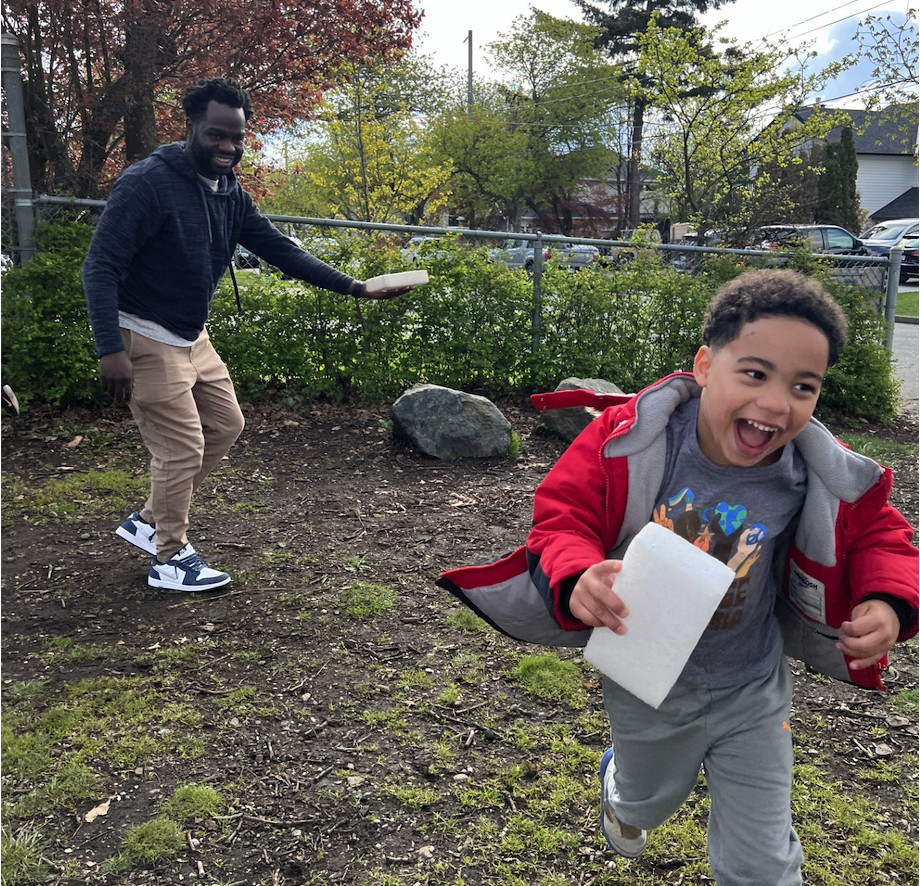
PLAYshop: Supporting parents in developing children’s physical literacy through purposeful play
Thank you to Morgan Potter and Valerie Carson, from the Faculty of Kinesiology, Sport, and Recreation, at the University of Alberta, for providing this post!
Before children are able to contribute to the game winning goal on their hockey team or deliver a flawless pass to their friend in the soccer game at recess, they need to build core fundamental movement skills along with their confidence and motivation. Unbeknownst to them, the foundations of these skills and abilities are being developed from a young age, contributing to their physical literacy development. However, with time spent playing actively being replaced with time indoors on screens, children may be missing out on the opportunities that contribute to their physical literacy potential.
The PLAYshop intervention was developed to address the growing public health issue of childhood physical inactivity with the aim of equipping parents with the confidence, knowledge, and availability of resources to support physical literacy development in their preschool-aged children (3-5 years). This age group of children are in a critical development window and typically spend many hours in the home environment, where parents have a large influence. By utilizing simple play equipment, household items, and some creativity – parents can create an environment where play is the focus, while the underlying purpose of physical literacy development occurs alongside.
What is PLAYshop?
PLAYshop is a novel theory-based physical literacy intervention specifically designed for parents with preschool-aged children. We utilize the International Physical Literacy Associations definition of physical literacy which is briefly described as the motivation, confidence, and physical competence to engage in physical activities for life. (1)
The main component of the PLAYshop intervention is a one-time 60-75 minute virtual or in-person workshop that teaches parents how to incorporate physical literacy-based active play with their children. Parent and child co-participation is encouraged throughout the workshop as majority of the workshop involves engagement in play activities. Parents leave the workshop with a deeper understanding of physical literacy and physical activity in children, a host of easy physical literacy-based active play activities to try at home, and follow-up support offered through educational handouts, access to online resources, and booster messages to encourage continued engagement with the PLAYshop activities.
Key Messages
The PLAYshop intervention is rooted in key physical literacy principles, and within the workshop we have embedded key messages to foster a supportive environment at home for physical literacy development. For example, we encourage the focus to be on play, keeping the activities fun and playful as a strategy to motivate children to engage in the play.
“It’s just seeing that and have fun and enjoy it and be active and obviously like getting involved in playing with them. I mean, that’s fun as a parent as well.” – parent/guardian
Creating a positive association with physical literacy-based active play may encourage children to come back to that activity in the future. Over time, with repeated positive exposures to activities, their confidence and skillset can grow.
We also discuss the importance of both indoor and outdoor play. The PLAYshop workshop introduces many activities that are designed for indoor spaces but can also be easily brought outside. We highlight the unique benefits of outdoor play on physical activity, reminding parents that when children play outside they move more, are on screens less, and play longer!
What have we learned about PLAYshop?
We have evaluated the PLAYshop intervention along the way. Parents have consistently reported an increase in their confidence, knowledge, and availability of resources to support their child’s physical literacy development. (2-5) We also found in our evaluations that parents who participated in PLAYshop modelled more physical activity and participated in more physical activity with their children. (2-3) In addition to this, interviews with parents 2-months post-workshop revealed that parents observed positive changes in their child’s confidence and skills in physical-literacy-related active play. (2) Many parents also commented on the increased connection they experienced with their child after participating in active play sessions together! (2)
“I didn’t realize how like quickly we would like just connect really quickly by doing these activities together. So that was really nice to see.” – parent/guardian
We know that parents play an influential role in a child’s life, so who better than parents to foster an environment that encourages play at all ages, working towards developing fundamental skills, motivation, and confidence to be physically active for life! Teaching parents these simple skills help to empower them to support their child in an additional and novel way.
“I feel like, like teaching someone how to draw or write, that’s something like you kind of know, but teaching like, I don’t know, physical literacy is something that no one’s ever like taught me how to do, so this is cool.” “I think I feel more confident in being able to do it and definitely see the benefits of focusing on those activities.” – parent/guardian
The PLAYshop intervention is expanding!
Up until recently PLAYshop workshops have been delivered directly by trained researchers. Through new funding we are now introducing an exciting opportunity for physical activity, physical literacy, recreation, and community leaders to become trained as a PLAYshop leader! If you are interested in learning how you can support parents of pre-school aged children in your community to incorporate physical literacy-based activities into their play, please contact us to learn more about our next virtual leader training opportunities. Virtual leader training opportunities are anticipated to take place in Spring/Summer 2026, but may be expanded with further interest and funding.
PLAYshop Leader Training: https://redcap.link/PLAYshopLeaderTraining
Contact Information: Morgan Potter, PLAYshop Coordinator, perbel@ualberta.ca
References
1. International Physical Literacy Association. Physical literacy definition. Published 2017. Accessed May 25, 2026. https://www.physical-literacy.org.uk
2. Carson V, Potter M, Hwang Y, Buckler EJ, Boyd M, Rhodes RE, Liu S, Moldenhauer R, Li J, Hills J, Naylor PJ. PLAYshop Randomized Controlled Trial: Efficacy and Implementation of a Virtually Delivered Parent-Focused Physical Literacy Intervention for Early Childhood. Scand J Med Sci Sports. 2025 Nov;35(11):e70161.
3. Hwang Y, Boyd M, Naylor P-J, Rhodes RE, Liu S, Moldenhauer R, Li J, Wright C, Buckler EJ, Carson V. Piloting the Virtual PLAYshop Program: A Parent-Focused Physical Literacy Intervention for Early Childhood. Children (Basel) 2023;10(4)
4. Lane C, Naylor PJ, Predy M, Kurtzhals M, Rhodes RE, Morton K, Hunter S, Carson V. Exploring a parent-focused physical literacy intervention for early childhood: a pragmatic controlled trial of the PLAYshop. BMC Public Health 2022;22(1):659
5. Lane C, Carson V, Morton K, Reno K, Wright C, Predy M, Naylor P-J. A real world feasibility trial of the PLAYshop: A brief intervention to facilitate parent engagement in developing their child’s physical literacy. Pilot Feasibility Study 2021;7113