
Thank you to Amy Jo, RECE, Resource Consultant with the SPROUT-Able project, CCOP and Children’s Inclusion Support Services for providing this post!
Take Me Outside Conference
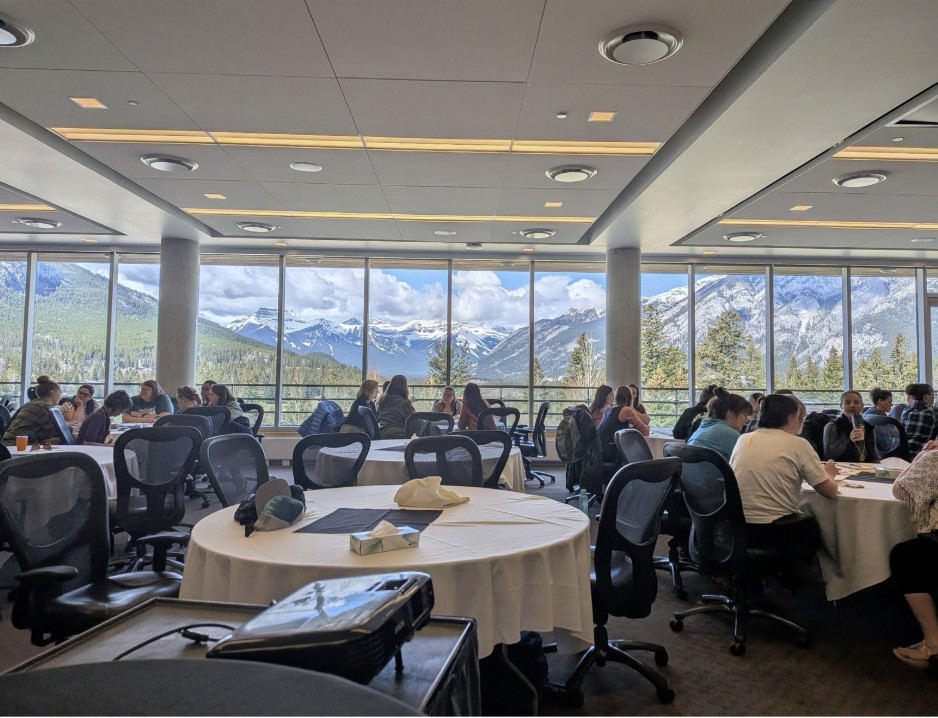
Allessia and I led a ‘mini’ World Cafe workshop – and the participants that attended were very engaged in
conversations about the physical and social barriers and facilitators to outdoor play and learning from each of their
own contexts. We began with a ‘barrier or facilitator?’ activity to get the group moving – then Alessia shared some of
the background of ‘What is a World Cafe’, and we talked about our experience at FE bringing together a diverse
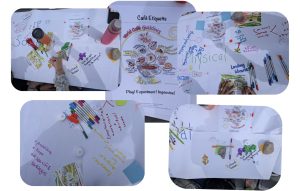
group of people to share their thoughts in discussion. We shared our postcards from the Graphic Recorder, and
encouraged the group to record their own thoughts with the creative items provided. Participants shared experiences
as educators, parents of children with special needs, or from lived experience. One reminded us ‘Nothing for us,
without us’ should embed the work that we do. The discussion led to conversation around ‘Sometimes there is not a
‘one right answer’, but we can ask good questions, explore possibilities – and that can lead to hopeful changes.
Paula and I were also part of a panel session – joined by an Educator from Australia, Daniel Burton, https://educatedbynature.com/ and another from Alberta, Rochellie Lywin (who I discovered is on the OPC Board of Directors : ) – Paula facilitated a discussion with us as panelists, and then small group discussions on risky play, etc. These were some of the questions we discussed.
- How do we establish trusting relationships with adults who don’t feel comfortable with risk in the early years?
- Are we truly advocating for what is best for children? Or are we still designing experiences that make us as adults feel comfortable?
- Where does your own discomfort show up in risky play, and how does it shape your responses?
- What does deep nature connection require from educators beyond just being outside?
- What would it take for you to trust children more? What would need to change internally or systemically?
- Are we allowing nature to be the teacher? Or are we still centering ourselves as the experts?
- What would a ‘yes audit’ of your setting reveal – (outdoor learning space?) look like? Where are you saying ‘no’ and why?
- What are the conversations we can have with families/supervisors/team to navigate risky play in a different way?
- What is something you can do on Monday, back in your setting, that changes your practice outdoors?
Highlights from Prince George training with CCRR:
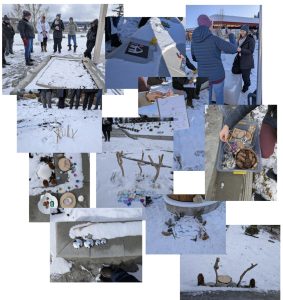
Watching the enthusiasm of the educators as they reflected on and created their ‘special spots’ in nature – both from their
childhood and currently. There were connections made from their childhood spots to how often they were ‘roaming free’, away from
the watchful eye of adults, which led to some reflective conversations about ‘overprotection’ of children, challenge by choice, and
building resilience and problem solving.
Seeing the incredible variety of loose parts the educators contributed, and the rich conversation about using loose parts to support
inclusion. (I also learned a lot about different areas of BC through their descriptions of their ‘special spots’! )
Hearing the rich discussions around risky play, health needs, sensory needs etc. – seeing the consultants get ideas from each other
and inspired for their own network. One was excited about connecting for community donations towards a clothing library – another
was excited to try a crock pot with bean bags for warming children who got chilly in the winter weather. : )