

Umbrella Review on the Relationship between Active Outdoor Play and Physical, Social, Mental, and Spiritual Health
This post was written by Louise de Lannoy, Michael Down, Javier Sayavera, Peter Bentsen, Richard Larouche, Eun-Young Lee, Leigh Vanderloo, Lærke Mygind, Trish Tucker, Avril Johnstone, Alessandra Prioreschi, Stephanie Prince Ware, Maeghan James, Arlene McGarty alongside the other 11 co-authors of this manuscript (see all names and affiliations below).
Highlights
- Active outdoor play is linked with better physical, social, mental, and spiritual health across the life course.
- The strongest evidence was for mental health benefits, including emotional wellbeing, reduced stress and anxiety, self-esteem, happiness and restoration.
- The evidence found was mostly from high-income countries. There is need for more research in low- and middle-income countries and with more diverse contexts.
- The project helped inform the 2025 Position Statement on Active Outdoor Play. This will support future national and international policy, practice, and research on active outdoor play.
Overview
In 2015, a group of outdoor play advocates and leaders came together to discuss a growing and collective concern over the impact of rapidly changing lifestyles (e.g., excess indoor and screen time and not enough time spent outdoors and in play) on children’s health. This group, many of whom later founded Outdoor Play Canada, developed the 2015 Position Statement on Active Outdoor Play.
For the 2025 Position Statement, we adhered to the PLaTO-Net definition of active outdoor play: Voluntary engagement in activity that takes place outdoors and involves physical activity of any intensity that is fun and/or rewarding and usually driven by intrinsic motivation.
The 2015 Position Statement helped galvanize the outdoor play movement both in Canada and globally. The evidence summary that supported the statement specifically called for more high-quality research on active outdoor play to guide policy in Canada. Over the last 10 years since that Statement was published, in Canada, we observed a 10-fold increase in outdoor play scientific publications since 2015, with the greatest number of new publications amongst children, youth and adults focusing on health, including 17 review papers exploring associations between spending time outdoors and physical, mental, social, and emotional health (see publication links here and here). This has been further extended by work elsewhere; for example, international colleagues recently compiled evidence across 59 studies (see publication links here and here) showing that outdoor play and learning in the early years is associated with improved physical and mental health, as well as improved social and emotional wellbeing.
Given the rapid pace by which research in this area has expanded, keeping up with the best available evidence can prove challenging, not just for researchers, but also for practitioners and policy makers. Therefore, we conducted an umbrella review (i.e., a review of reviews) to summarize systematic review evidence exploring the relationship between active outdoor play and overall health – physical, social, mental, and spiritual health. In alignment with the PLaTO-Net definition of active outdoor play, we additional sought to explore this relationship across all ages.
This umbrella review additionally served to inform the ten-year update of the Position Statement on Active Outdoor Play. The 2025 Position Statement on Active Outdoor Play was a global effort led by an 11-person international leadership group and a 143-person steering committee and was informed by 12 reviews including this one. To learn more about that project, click here.
Methodology
To conduct this umbrella review, we used a systematic literature search of eight scholarly databases to identify quantitative, qualitative, and mixed-methods systematic reviews examining the relationship between active outdoor play (including active outdoor recreation and/or leisure) and human health. We used rigorous methods to assess the quality of the reviews included, as well to explore causality between active outdoor play and health outcomes.
Six systematic reviews synthesizing scientific evidence were included, summarizing evidence from 381 original articles. Of those, three reviews employed quantitative methods (i.e., numbers-based), one used qualitative methods (i.e., story-based) and two used mixed methods (i.e., a combination of both numbers and story-based). Most of the research came from high-income countries, highlighting a major gap in evidence on research from low- and middle-income countries.
Findings
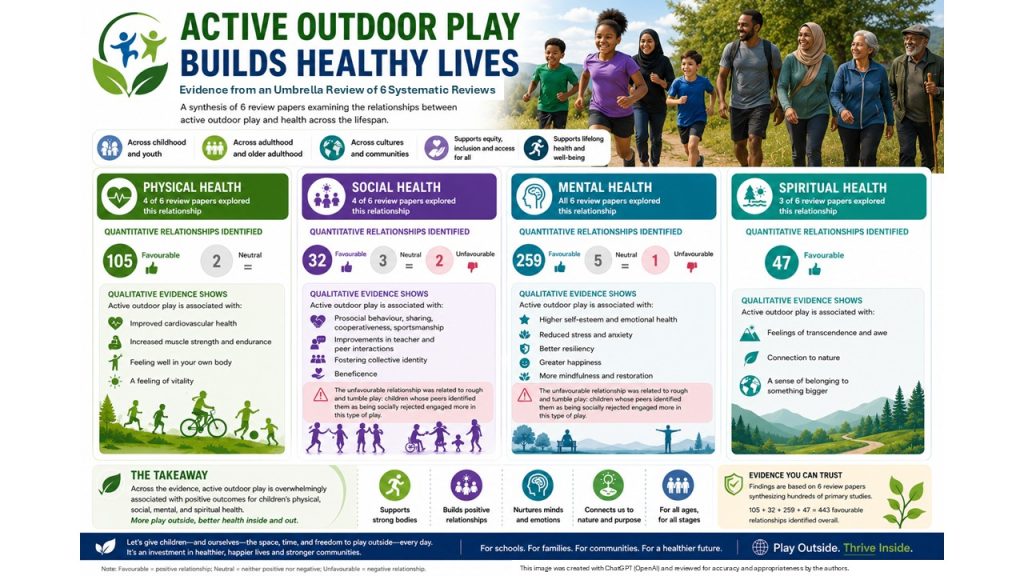
Overall, in this umbrella review we found strong and consistent evidence for playing actively outdoors and favourable associations with physical, social, mental, and spiritual health. See figure below for specific findings across these four dimensions of health from qualitative and quantitative studies.
Four of the six review papers explored the relationship between active outdoor play and physical health indicators. Findings from both quantitative and qualitative studies supported that engaging in active outdoor play is linked to better physical health including improved cardiovascular health, muscle strength, endurance, feeling well in your own body, and a feeling of vitality.
Four of the six review papers explored the relationship between active outdoor play and social health. Similar to physical health, findings from both quantitative and qualitative studies largely supported that engaging in active outdoor play is linked to better social health such as prosocial behaviour, sharing, cooperativeness, sportsmanship, improvements in teacher and peer interactions, fostering collective identity as well as beneficence. However, there were some adverse findings reported, where engaging in rough and tumble play was associated with less social acceptance in circumstances when girls and boys played together.
The greatest amount of evidence across all ages was found for mental health. All six review papers explored relationships between active outdoor play and indicators of mental health. Engaging in active outdoor play was associated with positive self-esteem, emotional wellbeing, reduced stress and anxiety, and better resiliency, happiness, mindfulness, and restoration. Some unfavourable relationships were again found for mental health in relation to rough and tumble play, where children whose peers identified them as being socially rejected tended to engage more in this type of play.
Three of the six reviews explored associations between active outdoor play and spiritual health. Engaging in active outdoor play was associated with feelings of transcendence and awe, connection to nature, and a sense of belonging to something bigger.
Conclusion
The findings from this review helped inform the 2025 Position Statement on Active Outdoor Play, which in turn, aims to guide future research, practice, and policy to support and promote outdoor play for people of all ages. In addition, this evidence reinforces the need for improved monitoring and evaluation of active play, to be able to contribute to and strengthen the evidence of such efforts like the Global Matrix, led by the Active Healthy Kids Global Alliance, which benchmarks physical activity, including active outdoor play, among children and adolescents globally.
Access the full publication here: https://doi.org/10.1123/jpah.2025-0391
This umbrella review was the product of a large international collaboration. We thank all co-authors of the full-length manuscript for their contributions:
Louise de Lannoy1*, Maeghan E. James1,2,3, Zainab Badruddin4, Anujah Thankarajah5, Peter Bakalár6,7, Lisa M Barnett8, Peter Bentsen9,10, Javier Brazo-Sayavera11, Valerie Carson12, Michael Down13, Scott Duncan14, Ryan Fahey1,15, Nevin J Harper16, Avril Johnstone17, Justin J. Lang2,18,19, Richard Larouche2,20, Eun-Young Lee 1,2,21, Olivia Lopes3, Taru Manyanga2,22, Ashley P McCurdy12, Arlene M McGarty23, Lærke Mygind9, Stephanie A. Prince24,25, Alessandra Prioreschi26, Suryeon Ryu27, Lindsey Sikora28, Patricia Tucker29,30, Leigh M. Vanderloo2,29,31, Lucy-Joy Wachira32, Mark S. Tremblay1,2,3,31
Affiliations
- Outdoor Play Canada, Canada
- Children’s Hospital of Eastern Ontario Research Institute, Ottawa, Canada
- Faculty of Medicine, University of Ottawa, Ottawa, Canada
- Lakehead University, Thunder Bay, Canada
- Department of Population Medicine, University of Guelph, Guelph, Canada
- Faculty of Sports, University of Prešov, Prešov, Slovakia
- Faculty of Physical Culture, Palacký University Olomouc, Olomouc, Czechia
- Institute for Physical Activity and Nutrition, School of Health and Social Development, Deakin University, Geelong, Australia
- Center for Clinical Research and Prevention, University Hospital Copenhagen – Bispebjerg and Frederiksberg, the Capital Region, Denmark
- Department of Geosciences and Natural Resource Management, University of Copenhagen, Copenhagen, Denmark
- Department of Sports and Computer Science, Universidad Pablo de Olavide, Seville, Spain
- Faculty of Kinesiology, Sport, and Recreation, University of Alberta, Edmonton, Canada
- School of Education, University of Notre Dame Australia, Australia
- School of Sport, Exercise and Health, Auckland University of Technology, New Zealand
- Physical and Health Education Canada, Canada
- Faculty of Health, University of Victoria, Victoria Canada
- MRC/CSO Social and Public Health Sciences Unit, University of Glasgow, Scotland.
- Centre for Surveillance and Applied Research, Public Health Agency of Canada, Ottawa, Canada
- School of Epidemiology and Public Health, Faculty of Medicine, University of Ottawa, Ottawa, Canada
- Faculty of Health Sciences, University of Lethbridge, Lethbridge, Canada
- Department of Sport Industry Studies, Yonsei University, Seoul, South Korea
- Division of Medical Sciences, University of Northern British Columbia
- School of Health & Wellbeing, University of Glasgow, Scotland
- Centre for Surveillance and Applied Research, Health Promotion and Chronic Disease Prevention Branch, Public Health Agency of Canada, Ottawa, Canada
- School of Epidemiology and Public Health, Faculty of Medicine, University of Ottawa, Ottawa, Canada
- SAMRC Developmental Pathways for Health Research Unit, Department of Pediatrics, Faculty of Health Science, School of Clinical Medicine, University of the Witwatersrand, South Africa
- Department of Kinesiology, Recreation, and Sport Studies, University of Tennessee, Knoxville, USA
- Health Sciences Library, University of Ottawa, Ottawa, Ontario, Canada
- School of Occupational Therapy, University of Western Ontario, London, Canada
- Children’s Health Research Institute, London, Canada
- Department of Research & Evaluation, ParticipACTION, Toronto, Canada
- Department of Physical Education, Exercise and Sport Science, Kenyatta University, Kenya
Cover Photo by Dean Zhang on Unsplash