

The role of active outdoor play in fostering connection to nature and lifelong environmental stewardship
Louise de Lannoy1, Brianna Nasrallah2, Nicholas Hayhow 3, Ulises Charles-Rodriguez4, Kimberly Squires5, Zainab Badruddin6, Justin J Lang2,7, Shawnda A Morrison8, Po-Yu Wang9, Mark S Tremblay1,2, Eun-Young Lee1,2,10,11 provided this post (affiliations can be found at the end of this post).
We, as a global society, have shifted our lives such that the vast majority of our time is spent indoors and away from nature. At the same time, we are collectively facing complex environmental challenges, including climate change and biodiversity degradation. This juxtaposition in how we spend time in our daily life, is leading to an increasing sense of helplessness and climate anxiety, particularly among adolescents and young adults. Finding ways to reconnect our communities to nature and foster long-term environmental stewardship is now, more than ever, a key priority both for human health and the health of the planet.
Engaging in, and promoting outdoor play across the lifespan, is being recognized as a positive way to encourage time spent outdoors and rekindle one’s connection to nature for those of all ages. In this systematic review, we explored how active outdoor play across the lifespan relates to our sense of connection to nature and importantly, our willingness to care for the environment (i.e., environmental stewardship). We also looked at whether these relationships were positive or negative, and how they might change as people get older. For example, how might active outdoor play foster a strong connection to nature based on the experiences created in childhood, and whether this strong connection could lead to longer term environmental stewardship behaviours which would persist into adulthood.
To answer these questions, a systematic search of five academic databases was conducted, looking for studies on this specific topic, which included 51 articles in total, consisting of a mix of quantitative (i.e., numbers-based; n=22), qualitative (i.e., story-based; n=27), and mixed-methods (i.e., a combination of both numbers and story-based; n=2) research studies. To be included, a study needed to include people of any age, use trusted tools to measure a person’s connection to nature and/or environmental stewardship (if quantitative), and importantly, the study had to look at how active outdoor play was linked to either a connection to nature and/or environmental stewardship practices.
In this study, we found compelling and consistent evidence from both kinds of research studies. Quantitative studies found that spending time playing outdoors is indeed linked to a greater connection to nature, and an increased likelihood of a person engaging in positive environmental stewardship behaviours. Evidence from qualitative studies backed up the evidence, further suggesting that by fostering a strong nature connection bond, engaging in active outdoor play can help foster a lifelong commitment to environmental stewardship.
The qualitative evidence also provided important context for how these relationships may form in the first place. For example, early and immersive outdoor play experiences in childhood was found to lead to a better understanding and awareness of the many interconnections and interdependencies found within nature, during both childhood and adulthood. This awareness and understanding may lead to an interest in learning and reflecting about the environment in adulthood, which in turn may foster environmental stewardship. Our findings match earlier research that showed when human feelings like caring for nature or concern for the environment are strong, these are signs that people are more likely to help protect their surroundings by engaging in pro-environmental behaviours (e.g. more likely to recycle, pick up trash, volunteer at their local park, etc).
The figure (below) shows how outdoor play can lead to a stronger connection to nature and greater environmental stewardship throughout the lifespan. Themes identified from the qualitative data (e.g., early and immersive experiences, curiosity, reflection) were included in the figure, to provide additional context on how these relationships are created.
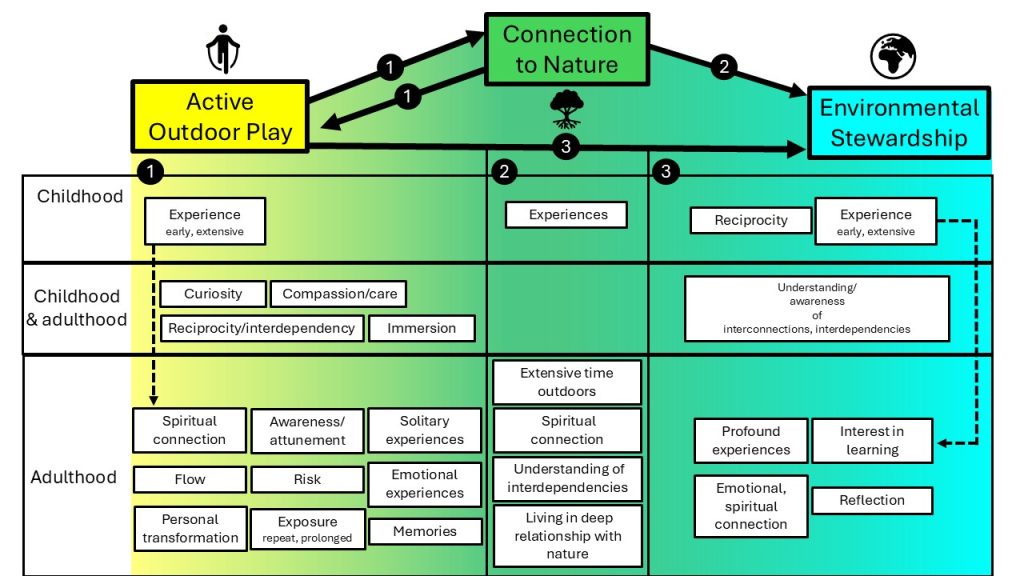
Our study found that connection to nature and environmental stewardship behaviours can occur in both childhood and adulthood, suggesting it is never too late to promote and engage in outdoor play!
Our findings also highlight several key qualities of outdoor play experiences (e.g., immersive, curiosity-driven) that program leaders and policy makers should incorporate or consider when they are designing outdoor play-based programmes, be it for childcare, schools, before or after school care, and adult recreation, to encourage people of all ages to connect with, and care for, the natural environment.
By combining the qualitative and quantitative findings together, we were able to gain a much richer understanding of the relationships between active outdoor play, connection to nature, and environmental stewardship compared to other studies. Our authorship group spans representation across three continents, and is the reason why we were able to translate the scientific abstract into 5 additional languages (when we were invited to do so at the journal’s request). However, since our authorship group represents countries exclusively from high-income countries, we acknowledge that our results might be biased in this way. Moreover, we found that the way in which outdoor play was measured and described varied substantially between and across age groups, making it difficult to conduct more in-depth analyses. In general, there was more literature found for active outdoor play in children than in adults, highlighting a need to continue the message that playing outside can be fun and rewarding for people of all ages!
This project was completed as part of a collection of 12 systematic reviews performed to underpin the information conveyed in the updated 2025 Global Position Statement on Active Outdoor Play. This paper, and the other reviews that helped inform the updated Position Statement, underscore how active outdoor play can cross-cut complex global environmental challenges, yet remain in alignment with many of the UN Sustainable Development Goals (e.g., SDG 11-15), where promoting an active lifestyle has long been recognized as an important contributor to this global effort. To learn more about the 2025 Position Statement project, click here.
Access the full publication here: https://doi.org/10.1002/pan3.70316
Author Affiliations
- Outdoor Play Canada, Canada
- Children’s Hospital of Eastern Ontario Research Institute, ON. Canada
- Department of Population Medicine, University of Guelph, ON. Canada
- Alberta Children’s Hospital Research Institute, University of Calgary, AB. Canada
- Department of Family Relations and Applied Nutrition, University of Guelph, ON. Canada
- Lakehead University, ON. Canada
- Centre for Surveillance and Applied Research, Public Health Agency of Canada, Ottawa, ON, Canada
- Yong Loo Lin School of Medicine, National University of Singapore, Singapore
- Department of Civic Education and Leadership, National Taiwan Normal University, Taipei, Taiwan
- School of Kinesiology & Health Studies, Queen’s University, Kingston, Canada
- Department of Sport Industry Studies, Yonsei University, Seoul, South Korea
Cover photo by Juliane Liebermann on Unsplash